
How Amazon's Search Algorithm Decides Which Products Rank
When shoppers search on Amazon, they expect to find the products they're most likely to purchase—not necessarily the products with the biggest advertising budgets or the lowest prices.
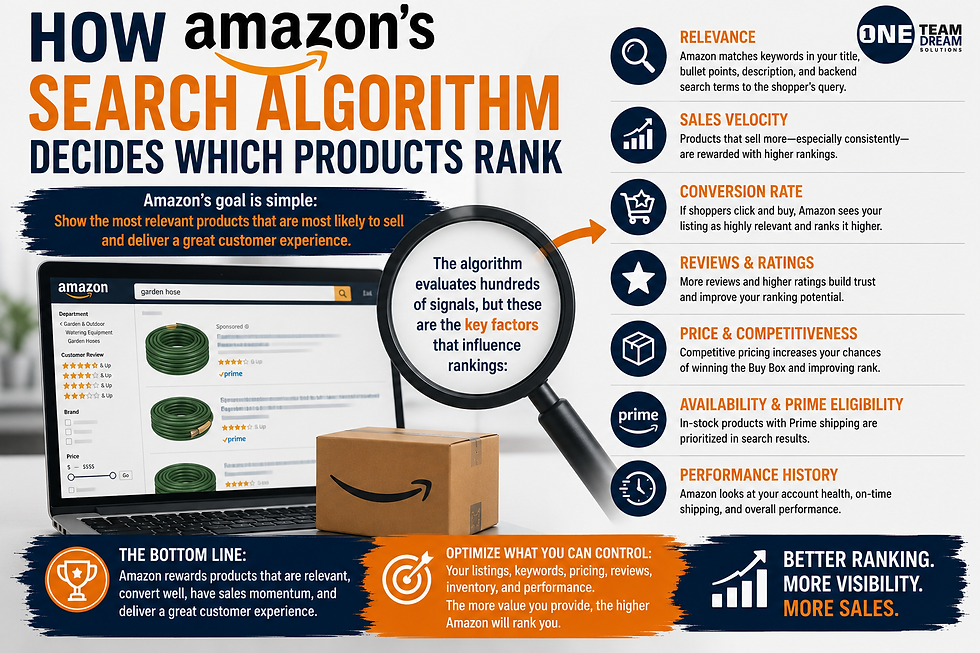
Amazon's search algorithm is designed with one goal in mind:
Show shoppers the products they are most likely to buy.
Every search result is carefully ranked based on hundreds of signals that help Amazon determine which products provide the best shopping experience.
Many sellers believe ranking is random or that spending more on advertising automatically moves products to the top. The reality is much more strategic.
Understanding how Amazon's search algorithm works is one of the most valuable steps you can take toward growing your business.
What Is Amazon SEO?
Amazon SEO (Search Engine Optimization) is the process of optimizing your product listings so they appear higher in Amazon's search results.
Unlike Google, which tries to answer questions, Amazon's search engine is focused on one thing:
Selling products.
Every ranking decision is based on which products Amazon believes will generate the highest customer satisfaction and the greatest likelihood of a purchase.
The better your listing performs, the more visibility Amazon is likely to give it.
Relevance: It Starts with Keywords
Before Amazon can determine how well a product performs, it first needs to understand what the product actually is.
That's where relevance comes in.
Amazon evaluates whether your listing matches what customers are searching for by looking at:
Product title
Bullet points
Product description
Backend search terms
Product attributes
Category selection
If your listing doesn't include the keywords customers use, Amazon has little reason to display it.
Keyword research is the foundation of every successful Amazon listing.
Sales Velocity Signals Popularity
Once your listing is considered relevant, Amazon evaluates how well it sells.
Products that consistently generate sales demonstrate customer demand.
Higher sales velocity tells Amazon:
Customers are finding the product.
Customers are buying the product.
Customers are satisfied with the purchase.
As a result, Amazon often rewards strong-performing products with increased visibility.
Consistent sales are generally more valuable than occasional spikes.
Conversion Rate Matters More Than Clicks
Getting shoppers to click your listing is only part of the equation.
Amazon also measures what happens after they arrive.
If many shoppers click your listing but don't purchase, Amazon may conclude the product isn't meeting customer expectations.
Several factors influence conversion rate:
Professional product images
Clear product titles
Compelling bullet points
Competitive pricing
Strong reviews
High-quality A+ Content
The more shoppers who convert into buyers, the more confidence Amazon has in showing your product to future customers.
Reviews Build Trust
Customer reviews play an important role in Amazon's ranking system.
While reviews alone won't guarantee high rankings, they heavily influence customer buying decisions.
Products with:
Higher ratings
More reviews
Consistent recent feedback
typically convert better than products with little or no social proof.
Higher conversion rates often lead to improved rankings over time.
Reviews create a cycle of success:
More trust → More sales → Better rankings → More visibility → Even more sales.
Pricing Influences Competitiveness
Amazon wants customers to feel confident they're receiving good value.
Products priced significantly above similar competitors may struggle to convert.
Products priced too low may generate sales but sacrifice profitability.
Successful pricing strategies balance:
Customer expectations
Competitive positioning
Profit margins
Advertising costs
Marketplace demand
Pricing isn't about being the cheapest.
It's about delivering the best overall value.
Inventory Availability Impacts Rankings
One of the most overlooked ranking factors is inventory.
Amazon wants to recommend products that customers can receive quickly.
If inventory becomes limited or goes out of stock, Amazon may reduce your visibility because it cannot confidently fulfill customer orders.
Healthy inventory supports:
Prime availability
Faster shipping
Better customer experience
Consistent sales velocity
Higher rankings
Running out of inventory doesn't just stop sales—it often disrupts months of ranking progress.
Advertising Can Accelerate Growth—But It Doesn't Replace Optimization
Amazon PPC (Pay-Per-Click) advertising is an important tool for increasing visibility.
However, advertising alone doesn't determine rankings.
Instead, advertising creates opportunities.
If your listing converts well, advertising can generate additional sales that improve sales velocity and reinforce Amazon's confidence in your product.
If your listing performs poorly, increasing ad spend usually increases costs—not rankings.
Think of advertising as fuel.
A well-optimized listing becomes a high-performance engine.
A weak listing simply burns through the fuel faster.
Customer Experience Matters
Amazon closely monitors customer satisfaction after the sale.
Factors that influence long-term ranking include:
Return rates
Order defect rate
Customer feedback
Shipping performance
Account health
Policy compliance
Products that consistently deliver positive customer experiences are more likely to maintain strong rankings over time.
Amazon's Algorithm Rewards Complete Optimization
Many sellers focus on just one area of optimization.
The most successful brands optimize everything.
Strong rankings are usually the result of multiple factors working together:
Relevant keywords
High-quality images
Persuasive product copy
Competitive pricing
Healthy inventory
Positive reviews
Effective advertising
Excellent customer experience
When these elements align, Amazon sees a product that shoppers are likely to purchase—and continues rewarding it with greater visibility.
Amazon SEO Is an Ongoing Process
Amazon's marketplace changes every day.
Competitors adjust pricing.
New products enter your category.
Customer search behavior evolves.
Advertising costs fluctuate.
Search rankings are never permanent.
Successful brands continually monitor performance, refine keywords, optimize listings, test new strategies, and adapt to changing market conditions.
Amazon SEO isn't something you complete once.
It's an ongoing process of continuous improvement.
How One Team One Dream Solutions Helps Brands Improve Amazon Rankings
At One Team One Dream Solutions, we know that ranking higher on Amazon requires far more than simply adding keywords to a product title.
Our team takes a comprehensive approach to Amazon SEO by optimizing every factor that influences visibility and conversions.
Our services include:
Comprehensive keyword research
Amazon listing optimization
Title and bullet point optimization
Backend search term management
A+ Content creation
Brand Store development
Professional advertising management
Inventory planning
Pricing strategy
Performance analysis and reporting
As your Amazon marketing partner, we continuously optimize your listings, monitor performance, and manage advertising campaigns within the budget you establish—all with the goal of maximizing visibility while protecting your profitability.
As your Amazon distribution partner, we go even further by purchasing inventory, managing replenishment, forecasting demand, optimizing listings, and handling Amazon operations so you can focus on building your brand and growing your business.
Our goal is simple:
Help your products rank higher, convert better, and grow profitably.
Ready to Improve Your Amazon Rankings?
If your products aren't getting the visibility they deserve, it may not be your product that's holding you back—it may be your Amazon SEO strategy.
Whether you need an experienced Amazon marketing team or a full-service distribution partner, One Team One Dream Solutions can help you build a strategy that drives long-term growth.
Schedule your free consultation today to discuss how we can help improve your Amazon rankings and grow your business.
Book your complimentary consultation here:


Comments