
Why Healthy Inventory Is One of the Biggest Drivers of Amazon Success

When most businesses think about growing on Amazon, they focus on advertising, product listings, or reviews.
While those are all important, one of the biggest factors affecting sales is something much less exciting—but far more impactful:
Inventory management.
Running out of inventory or allowing stock levels to get too low doesn't just cost you sales today. It can negatively impact your rankings, advertising performance, customer experience, and even increase the fees you pay to Amazon.
Maintaining healthy inventory is one of the foundations of a successful Amazon business.
Inventory Doesn't Arrive Overnight
Many sellers assume that once they ship products to Amazon, those products are immediately available for customers to purchase.
Unfortunately, that's rarely the case.
After inventory leaves your warehouse or manufacturer, it typically goes through several stages:
Transit to Amazon fulfillment centers
Receiving and unloading
Check-in and processing
Inventory becoming available for sale
Under normal conditions, this process can take 1–3 weeks, depending on shipping method, warehouse capacity, and seasonal demand. During Prime Day, Q4, or other high-volume periods, receiving times can take even longer.
Planning inventory shipments only when you're running low is often too late.
Prime Availability Takes Even Longer
Many sellers are surprised to discover that inventory being "Available" doesn't automatically mean every customer sees the Prime badge with one- or two-day delivery.
Amazon's fulfillment network works by redistributing inventory throughout its regional fulfillment centers based on expected customer demand.
After inventory is received, Amazon may spend an additional several days to roughly 2–4 weeks relocating units throughout its network so products qualify for the fastest Prime delivery across more regions. This process varies based on demand, sales velocity, and geography. During this time, customers farther from the receiving fulfillment center may see longer delivery estimates.
The more inventory Amazon has available to distribute, the better your nationwide Prime coverage typically becomes.
Why We Recommend Maintaining 45–60 Days of Inventory
For most established products, maintaining approximately 45–60 days of available inventory provides an excellent balance between:
Maintaining Prime availability
Avoiding costly stockouts
Allowing enough time for replenishment shipments
Minimizing storage costs
Supporting advertising campaigns
Maintaining organic rankings
Waiting until inventory reaches only a few weeks of supply often creates unnecessary risk.
If a shipment is delayed—or demand unexpectedly spikes—you can quickly find yourself out of stock.
What Happens When You Run Out of Stock?
Many sellers think the only consequence is temporarily losing sales.
Unfortunately, the impact goes much further.
Organic Search Rankings Decline
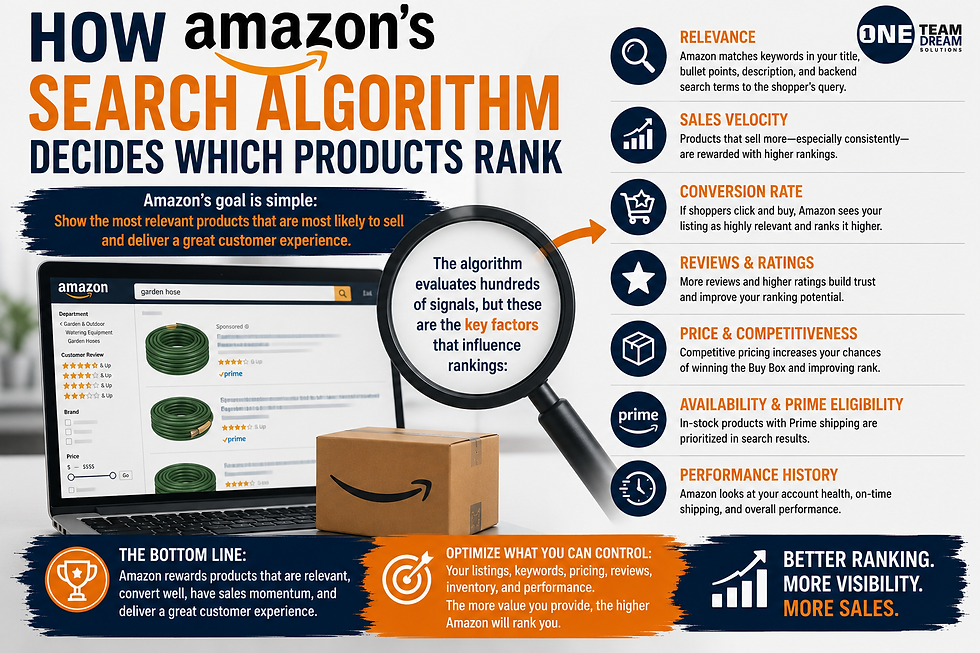
Amazon's algorithm rewards products that consistently sell.
When inventory reaches zero, sales stop.
As sales stop, rankings often begin to decline.
Recovering those rankings can take weeks—or even months—after inventory returns.
Advertising Performance Suffers
If PPC campaigns continue while inventory is limited, Amazon has fewer opportunities to gather conversion data.
Campaign optimization slows.
If products go completely out of stock, campaigns pause entirely and often require time to regain momentum after inventory returns.
Prime Coverage Shrinks
Even before inventory reaches zero, low stock levels can reduce Amazon's ability to distribute inventory across its regional fulfillment network.
Customers farther away may begin seeing:
Longer delivery dates
Delayed Prime delivery
Reduced Buy Box competitiveness
All of these factors can lower conversion rates.
Lost Sales History
Amazon rewards consistent sales velocity.
Interruptions caused by inventory shortages can impact:
Best Seller Rank (BSR)
Organic keyword rankings
Category positioning
Buy Box performance
Overall sales momentum
Those are difficult metrics to rebuild once they're lost.
Low Inventory Can Cost You More
Amazon now charges a Low Inventory Level Fee on eligible FBA products when both the short-term and long-term historical days of supply fall below 28 days. The fee applies on a per-unit basis and varies by product size and inventory level.
This means poor inventory planning can increase your fulfillment costs in addition to hurting sales.
Understanding Amazon Storage Fees
Some sellers become so focused on avoiding storage fees that they unintentionally create much larger problems by keeping inventory too lean.
Storage fees are simply another cost to optimize—not necessarily eliminate.
Monthly Storage Fees
Amazon charges monthly storage fees based on cubic feet occupied.
Typical rates are lower from January through September, then increase significantly during October through December, when warehouse space is at a premium for the holiday season.
Generally speaking:
January – September
Lower monthly storage rates
October – December
Higher peak-season storage rates
Aged Inventory Surcharges
Inventory that remains in Amazon fulfillment centers for extended periods incurs additional aged inventory surcharges.
In 2026, these surcharges begin after 181 days in storage and increase as inventory ages further, making slow-moving inventory progressively more expensive to hold.
The goal isn't to avoid inventory.
The goal is to maintain healthy, fast-moving inventory.
Finding the Right Balance
The most successful Amazon businesses don't carry excessive inventory.
They also don't operate with only a few weeks of supply.
Instead, they forecast demand carefully while accounting for:
Manufacturing lead times
Ocean or ground transportation
Amazon receiving delays
Regional inventory transfers
Seasonal demand spikes
Advertising promotions
Prime Day
Holiday sales
Healthy inventory planning allows every part of your Amazon business to perform better.
How One Team One Dream Solutions Removes This Burden
Managing inventory isn't just about ordering more products.
It requires forecasting, monitoring sales trends, planning replenishment shipments, and constantly balancing inventory levels against Amazon's evolving fee structure.
That's exactly what we do.
Through our Amazon Distribution Partnership, One Team One Dream Solutions purchases inventory directly from our brand partners and assumes the responsibility of forecasting, replenishment planning, inventory management, and Amazon operations.
We work to maintain healthy inventory levels that support:
Consistent Prime availability
Strong organic rankings
Efficient PPC campaigns
Healthy Buy Box performance
Lower risk of stockouts
Optimized inventory turns
Reduced low-inventory penalties
Controlled storage costs
Instead of worrying about when to reorder, how much to send, or whether Amazon has enough inventory distributed across its fulfillment network, you can focus on what you do best—developing great products and growing your business.
Healthy inventory isn't just an operational task—it's a competitive advantage.
At One Team One Dream Solutions, we combine forecasting, inventory planning, advertising, listing optimization, and marketplace expertise to help brands maximize sales while minimizing unnecessary costs.
Whether you're looking for a full-service Amazon distribution partner or an experienced team to manage your Amazon business, we're ready to help you build a more profitable and resilient operation.
Schedule a free consultation today to learn how our inventory management strategies can keep your products selling, your Prime coverage strong, and your Amazon business growing.


Comments